
For Technical architect · SRO · SIRO · Platform engineer
Key points
- Moving an AWS account does not, by itself, establish that legal responsibilities have transferred. The authority and effective date for each function, records custody, pending information requests, data protection roles and supplier contracts each need to be settled and documented separately.
- Since November 2025, AWS Organizations supports direct transfers between organisations without a standalone step. The seller of record must match, a source service control policy that denies leaving will block the move, and the account arrives at the destination root, so the receiving department should prepare and test the target OU in advance.
- Several dependencies do not move with the account: KMS keys held in another account, a centrally bought Savings Plan, a transit gateway in the losing department's network account and historic CloudTrail logs. By default, shares that rely on organisation membership are lost, so if the moving account still needs a shared resource, such as that transit gateway while the receiving department builds its own connectivity, a compatible account-to-account share must be set up and tested in advance, and policies that use
aws:PrincipalOrgIDstop matching and must be updated on both sides. - Sign-in arrangements should not be assumed to survive. Plan to provision fresh IAM Identity Center access in the receiving organisation, check policies that reference generated
AWSReservedSSO_role ARNs, and make sure the receiving department controls the account email and has a tested recovery or privileged-access procedure. - Account transfer is not always the right strategy. Where one account serves functions that will belong to different departments, the workload must be separated first, and the transfer step comes last.
- The change is done when the receiving department can show it runs the service on its own, the losing department can show it has given up access it should no longer hold, and both can still find the evidence that explains past decisions.
In July 2026 the government announced a substantial reorganisation of departmental responsibilities, including the transfer of the Government Digital Service into an expanded Department for Digital, Culture, Media and Sport, the redistribution of functions previously held by the Department for Science, Innovation and Technology, and the creation of a OneGov Delivery Agency intended to bring several operational services together at arm's length from the Cabinet Office. The announcement did not set out effective dates for each transfer, and the legal and operational arrangements for individual functions are settled separately, but it shows how quickly established departmental boundaries can change. Once they do, the technical infrastructure supporting those functions has to accommodate a new pattern of ownership and accountability.
Reorganisations of this kind recur throughout British government, so an estate designed to operate for many years should allow for the possibility that a service will be split, merged or handed to a different owner during its life. This article sets out what a machinery of government change asks of an AWS estate, what AWS Organizations now allows, what it leaves for the two departments to resolve, and how to organise the work so that the receiving department can show it is able to run the service on its own.
What a machinery of government change requires
Machinery of government changes can transfer functions between ministers and, in some circumstances, between ministers and public bodies. Major changes involving ministerial departments commonly require an Order in Council under section 1 of the Ministers of the Crown Act 1975, which permits the transfer of functions and allows associated provision for property, rights, liabilities, contracts and continuing proceedings. The 2021 Order establishing the Department for Levelling Up, Housing and Communities is a concrete example: it expressly transferred functions and property, rights and liabilities. The extent of any transfer must be established from its legal authority and the provisions that apply to the particular function.
The constitutional position is more varied than a single transfer-order process suggests. The Cabinet Manual explains that some reallocation between secretaries of state can take effect administratively before an Order is made, while other statutory functions cannot move until the necessary instrument is in force; changes extending beyond ministerial departments may require primary legislation. For technical planning, both departments therefore need an agreed statement of the authority and effective date for each function, together with the treatment of its contracts, information and operational responsibilities. An announcement, or the successful migration of an AWS account, does not itself establish that these legal responsibilities have transferred.
The National Archives explains that records covered by the Public Records Act retain their public-record status through the change, even where their custodian changes, and advises the organisations to establish a joint information management team, agree which records move and preserve their technical, contextual and content integrity. Holding a record, being legally responsible for it and acting as controller for personal data within it are different questions, each of which needs to be settled and documented.
Information-rights requests must also survive the change. The ICO advises that, where responsibility for a pending request transfers to a successor authority, the original response period is not extended merely because the organisation has changed. A different situation arises where an existing authority does not hold requested information and, with the requester's agreement, forwards a request to another authority: the receiving authority then has its own statutory response period. Both departments should establish who holds historical and current information, who answers pending FOI, environmental-information and subject-access requests, and how they will obtain records held on one another's behalf.
The Cabinet Office's published guidance on planning a machinery of government change has been withdrawn, and the GOV.UK page now directs departments to its machinery of government team. In practice most of the technical planning falls to the departments and their suppliers, usually under tight timescales and without a template for the cloud estate.
A worked example
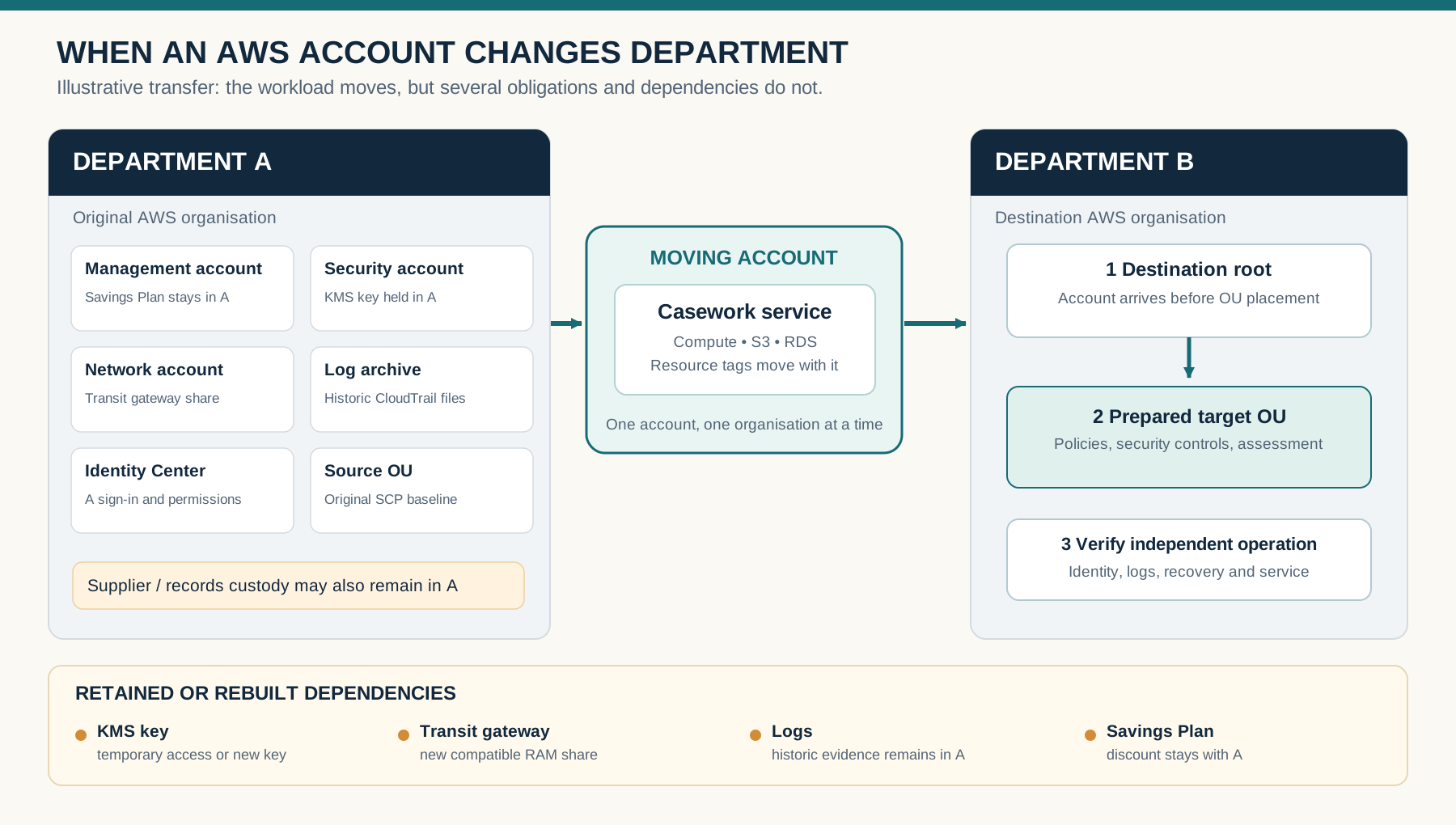
To keep the AWS detail connected, the rest of this article follows one hypothetical service. A casework application run by Department A is moving, with its function, to Department B. It runs in a single workload account inside A's AWS Organization, in an OU whose service control policies enforce A's baseline. It connects to other systems through a transit gateway shared from A's network account. Its documents sit in Amazon S3, encrypted under a customer managed key held in A's central security account, while its Amazon RDS snapshots use the default AWS managed key. Its operators sign in through A's IAM Identity Center, its compute is discounted by a Compute Savings Plan bought in A's management account, and its activity is recorded by A's organisation trail into A's log archive account.
None of those arrangements is unusual or poorly designed. Each one, however, needs a different treatment when the account changes owner.
Moving accounts: what changed in late 2025
Until recently, moving an account between AWS Organizations meant removing it from the source organisation, running it briefly as a standalone account with its own payment method and support plan, and then accepting an invitation from the destination. Since November 2025, AWS Organizations has supported direct transfers, in which the destination organisation invites the account and accepting the invitation moves it across without the standalone step, so the account remains within an AWS organisation throughout the move, although the applicable policies and billing relationships change at the organisation boundary. Much of the guidance still found online describes the older process and should be treated as out of date.
Several constraints still matter in government. The account and the destination organisation must have the same seller of record, the AWS entity that contracts for and bills the account, or the transfer fails, so this should be checked for every account early. A service control policy in the source organisation that denies leaving the organisation will block the transfer even when the account's own permissions allow it, which is a sensible protection in normal operation that has to be lifted deliberately for the change. Newly created member accounts must be at least four days old, the destination organisation must be at least seven days old, and if the account being moved is the management account of its organisation, every member has to be removed and the organisation deleted first.
Where the account lands, and which controls apply
A transferred account is placed at the root of the destination organisation, and AWS advises checking its policies and OU permissions before moving it into an OU. For a government estate this is the step that deserves the most care, because the receiving department's baseline controls, whether service control policies, resource control policies or AWS Control Tower controls, usually depend on OU membership. An account sitting at the root is governed only by whatever applies at the root, which in many organisations is deliberately permissive.
The receiving department should therefore prepare the target OU in advance, with the policies the service will need already attached and tested against a comparable account, and move the transferred account into it as part of the same planned change. Since November 2025, AWS Control Tower has supported automatic account enrolment on movement into a governed OU, but this is an opt-in feature for eligible landing zones running version 3.1 or later, so the receiving department must confirm that it is enabled and supported before treating enrolment as an automatic step. The effective permissions in the account should then be verified after placement, because a deny inherited from the receiving organisation can stop a running service in ways the losing department's controls never did.
Root user custody
Root custody needs an account-specific plan because AWS now supports two materially different operating models. Where a member account has recoverable root credentials, AWS's migration guidance advises preparing access for the new owner, removing existing root MFA before migration if necessary to permit the handover, and controlling the timing of any root email change according to whether the destination organisation has all features enabled. Such a handover should take place within a tightly controlled change window, with appropriate alternative administrative access and immediate post-transfer hardening.
Where an organisation uses AWS's centralised root access capability, member-account passwords and MFA devices may have been removed altogether, so requiring the receiving department to register a new standalone root MFA device would undermine the existing security model. The two departments must instead verify whether credential recovery is enabled, which management or delegated administrator can perform privileged root actions, and how those capabilities change at the organisation boundary. In either model, the receiving department needs control of the account email and a tested recovery or privileged-access procedure, while the losing department must demonstrate that it has relinquished access routes it should no longer retain.
What does not follow the account
Several things do not move with the account, or do not tidy themselves up afterwards. The table in the next section lists each item in the worked example; these are the mechanisms behind the most common failures.
- Policies that name the old organisation. IAM, bucket and key policies that use the
aws:PrincipalOrgIDcondition stop matching once the account has a new organisation ID. These need to be found and updated on both sides, so that the moving account keeps the access it needs and the losing department removes access it no longer intends to grant. - Roles that trust the old management account. Roles such as
OrganizationAccountAccessRoleare not deleted automatically, and continue to trust the losing department's management account until someone removes them. - Organisation-level reports and history. These are deleted when the account leaves, so billing data and organisation-level reports should be exported beforehand, while member-account data such as CloudTrail event history and the account's own billing history remains available.
- Delegated administration and trusted access. An account registered as a delegated administrator must be deregistered before it can leave, and services that rely on trusted access, such as organisation-wide security tooling, need checking on both sides. AWS provides an account assessment tool that lists delegated administrators, policies and services with trusted access enabled.
What follows the account, and what does not
The table summarises the worked example. An entry in more than one column means that the resource or setting changes ownership while a related dependency still requires separate treatment.
| Item | Moves with workload account | Remains with Department A | Must be prepared or reworked |
|---|---|---|---|
| Workload resources and resource tags | Yes | Validate new organisational controls | |
| Account and OU tags | Source metadata retained by A | Recreate in B | |
| KMS key in A's security account | Yes | Time-limited authorised use or replacement under B's custody | |
| RDS snapshots encrypted under the account's AWS managed key | Yes | Re-encrypt under a customer managed key if a cross-account share or copy is required | |
| Savings Plan purchased centrally by A | Yes | B forecasts replacement discounts and costs | |
| IAM Identity Center assignments and generated roles | Do not assume continuity | A's organisation-specific assignments cease to provide an authorised route; cleanup timing requires testing | Prepare B's identity model, then provision account assignments and check referenced role ARNs after arrival |
| Organisation trail and historic logs | New coverage must be validated | Historic log files remain in A's archive | Verify delivery, retention and B's request route |
| Old management-account trust roles | Yes, until removed | Revoke obsolete trust | |
| Shared transit gateway | Attachment may remain | Gateway remains in A's network account | Create compatible RAM share in advance and test network paths |
| Supplier agreements | Depends on legal and commercial arrangements | May remain with A | Transfer, novate or replace as applicable |
Shared resources: keeping the share is only part of it
Many estates share resources across accounts through AWS Resource Access Manager, as with the transit gateway in the worked example. By default, an account leaving an organisation loses access to resource shares that rely on that organisation's membership, including shares directed to an OU or the organisation itself. AWS RAM now offers RetainSharingOnAccountLeaveOrganization, but its scope is narrower than the setting's name might suggest: it must be enabled when a new account-to-account share is created, requires external principals to be allowed, and involves an invitation that the consuming account must accept. It cannot be retrofitted to an existing share, does not preserve an OU-wide or organisation-wide share, and cannot be used for resources restricted to sharing within one organisation. The transfer plan must establish a compatible share in advance and test the service using it.
Retaining the share does not on its own guarantee that everything built on top of it keeps working. AWS's published pattern for AWS Lake Formation, which uses RAM behind the scenes for cross-account data catalogue permissions, relies on temporary bridge shares created before the move and on restoring principals in the original shares afterwards, which shows that each service built on a share needs its own check. For the casework service, the team would first create and accept a compatible account-scoped transit gateway share, then test the attachment, routing, firewall policies and any organisation-sensitive dependencies before and after the account moves.
There is also a governance consequence. After the transfer, a resource owned by one department is being shared with an account owned by another, and that dependency needs an accountable owner, an expiry condition and an exit plan, together with evidence when it has actually been removed. Where personal data flows across it, the continued access also needs a documented basis.
Encryption keys and custody
KMS keys belong to the account that created them and cannot be transferred between accounts. A transferred account brings its own customer managed keys with it, so the difficulty lies in keys held elsewhere. In the worked example, the casework documents are encrypted under a key in A's central security account, and they remain readable only for as long as that key's policy allows the moved account to use it.
Two patterns need attention. A key policy that grants use to the whole organisation through aws:PrincipalOrgID worked while everything sat in one organisation, and will silently stop granting access once the account moves. Data encrypted with AWS managed keys, such as the default RDS key used for the example's snapshots, raises a narrower problem: those key policies cannot be edited, so wherever the data has to be copied or shared across accounts, for instance to restore snapshots into a new account or to hand backups to the receiving department, it must first be re-encrypted under a customer managed key. If the account simply moves and its data stays inside it, that step may not be needed. Depending on data volumes, this re-encryption can be substantial, although in some separations the larger effort lies elsewhere, in extracting shared databases, rebuilding network connectivity or separating applications that were never designed to run independently.
The more lasting question concerns custody. There are good reasons on both sides. Keeping customer managed keys in workload accounts makes a service easier to move and keeps key administration close to the service, while centralising keys in a security account preserves separation of duties and gives an independent security team control over who can decrypt what. A machinery of government change does not settle which model is better, but it does require the receiving department to end up with independent authority over the keys protecting the function's data, through new keys under its own administration, a documented and time-limited arrangement with the losing department, or both. A service whose data can still be decrypted, or made unreadable, by a department that no longer owns it has an unresolved dependency.
Commitments and money
Savings Plans and Reserved Instances belong to the account that bought them, and when a Savings Plan owner account leaves an organisation, that plan no longer applies to the consolidated bill it used to reduce. Discount sharing cannot span separate organisations. In the worked example the Savings Plan sits in A's management account, so the casework service loses that discount the moment it leaves, while Department A keeps a commitment sized partly for usage that has gone.
AWS has also made commitment sharing more controllable within an organisation. Discounts can be shared organisation-wide, or through prioritised or restricted groups of accounts defined with a Cost Category, and individual commitments can be given their own sharing preference. Those settings help both departments see in advance which business areas a commitment actually serves, how much term remains, and what each side's bill will look like after the move, which is the conversation finance teams need to have before the transfer date. Budgets, cost categories, billing alarms, cost allocation tags, tax settings and support plans then all need reviewing in the destination organisation.
Identity, access and logging during the transition
In departmental estates using an organisation instance of IAM Identity Center, permissions are granted through assignments that connect a user or group, a permission set and an AWS account. AWS's Organizations integration documentation says that removing an account triggers cleanup of IAM Identity Center metadata and resources, including its service-linked role, while AWS's earlier account-migration guidance explains that the source instance ceases to manage the departing account and that the destination must configure its own account assignments. A direct transfer introduced in November 2025 avoids an intermediate standalone-account period, but the moving account still exits the original organisation, so the receiving team should plan to provision fresh access rather than assume that its previous sign-in arrangements will survive. The precise timing of cleanup and permission-role changes during a direct transfer is not documented clearly enough to treat as guaranteed; this should be tested with a representative account before a critical service is moved.
The receiving department can establish its identity source, groups, permission sets, necessary customer managed policies and emergency roles ahead of the change, but account-specific assignments cannot be completed against the incoming account in the destination organisation until the account is available there. The transfer runbook should provide a deliberately bounded alternative route for the cutover, create and verify the new account assignments immediately after the move, and test real operator access through the receiving department's access portal before retiring the former department's routes. This is an ownership transfer as well as a sign-in change: mapping staff by name or email alone is insufficient evidence that the two departments' identity stores and authorisations are equivalent.
A further risk lies in policies that refer directly to IAM Identity Center's generated roles. Permission-set assignments create roles whose names begin with AWSReservedSSO_, and AWS warns that deleting the last assignment and later recreating it can produce a role with a new ARN suffix. Resource policies or older EKS access configurations that embed the former ARN may then fail even though the replacement permission set looks identical. Before migration, identify such references in KMS, EKS and other trust configurations, ensure a stable emergency-access role is available, and validate the revised policies after the destination provisions its assignments. AWS has not published evidence that every direct transfer necessarily deletes these roles in the same sequence, so the warning is about a documented failure mode that must be assessed, not a claim that every moved account experiences it.
Logging needs the same treatment. CloudTrail's documentation is clear that when an account leaves an organisation, the organisation trail and its service-linked role are deleted from that account and logging for it stops, and that when an account joins an organisation, the destination's organisation trail is added and logging starts automatically. Log files created before the move stay in the losing department's trail bucket. AWS's older migration guidance suggests creating an account-level trail before the move to cover any gap, which remains a reasonable precaution, provided it is removed once the destination's trail is confirmed, because overlapping trails incur duplicate event charges.
The historical logs then raise the same questions as any other record. They may be needed to investigate an incident that began before the transfer, to answer an access request, or to support an audit of decisions taken under the old department, so the receiving department needs an agreed route to obtain them from the losing department's archive for as long as the relevant retention period runs. The same applies to backups held in a central backup account, to security findings held by a delegated administrator, and to configuration history.
Data protection responsibilities and supplier contracts
Moving a statutory function or an AWS account does not, by itself, determine the controller for every processing activity. Under the UK GDPR, controller responsibility turns on who determines the purposes and means of processing, subject to any controller designation made by law. The ICO's organisational-change guidance gives an example in which historical information remains with Department A while current service information passes to Department B. That example requires further analysis of whether A retains the information for its own records obligations or merely holds it on B's behalf, because custody, control and the purposes of processing do not necessarily coincide. The two departments are joint controllers only to the extent that they genuinely determine the purposes and means of particular processing together; holding or using related records for separate purposes does not automatically create joint controllership.
For ongoing casework, the receiving department must establish and document its own lawful basis for processing. Public task under UK GDPR Article 6(1)(e), read with section 8 of the Data Protection Act 2018, may be appropriate where processing is necessary for an official function with a basis in law, but one department cannot simply rely on another department's public task. If the records contain special category data, an appropriate Article 9 condition and any applicable Data Protection Act safeguards are also required. The transition should therefore prompt a review of privacy information, records of processing, data protection impact assessments where necessary, processor arrangements, security controls and information-rights handling. Where the departments genuinely act as joint controllers, Article 26 requires a transparent arrangement allocating responsibilities, while individuals retain their rights against each controller.
Contracts need a parallel but separate review. The relevant Crown, ministerial, departmental or supplier arrangements, and the legal provisions implementing the particular transfer, determine whether a managed-service, reseller or other contract moves by operation of law or instead requires variation, novation or replacement. The 1975 Act permits transfer orders to address contracts, and the 2021 example expressly transferred defined property, rights and liabilities, but neither establishes that every supplier contract automatically follows a workload account. Both departments should identify the actual contracting party, continuity of service, the treatment of any processor terms and the authority to incur ongoing charges. Budget responsibility and AWS discount entitlements must also be reconciled separately, because the Treasury's machinery-of-government budgeting process does not move a Savings Plan between AWS accounts.
From transfer decision to operational acceptance
Taken together, these mechanics need organising into a sequence that both departments' platform teams can work to and that a senior responsible owner can sign off. The phases below are one way to do that, each ending with evidence the other department can check.
| Phase | Work required | Evidence of completion |
|---|---|---|
| Establish scope | Identify functions, service owners, accounts, data stores, the legal or administrative authority and effective dates | Agreed transfer inventory and legal-authority record |
| Assess dependencies | Review keys, identity, networking, logging, budgets, contracts, information rights, controller arrangements and external services | Dependency, legal-responsibility and exception registers |
| Prepare the receiving estate | Prepare the target OU, root custody, identity, monitoring, backup, recovery, privacy and records-access arrangements | Destination readiness and information-governance records |
| Execute the transfer | Move the account through a controlled change, place it in the target OU, monitor dependencies and execute a rehearsed continuity or forward-recovery plan | Transfer change record |
| Verify operation | Test end-to-end casework, identity, encryption, dependencies, logging, recovery, billing and access to records for pending information requests | Signed operational and information-governance acceptance |
| Close transitional arrangements | Remove legacy roles, temporary shares, duplicate trails, retained key grants and supplier access that is no longer needed | Exception closure and evidence archive |
In the worked example, the dependency register would show that the account itself can move directly, that a compatible account-scoped transit gateway share must be created and accepted before the move if A's connection is needed temporarily while B builds its own connectivity, that the documents need either a time-limited grant on A's key or re-encryption under a key B controls, that the RDS snapshots need re-encrypting before any copy leaves the account, that B's Identity Center groups and permission sets must be ready before cutover while account-specific assignments are created and verified as soon as the account joins B, that the Savings Plan stays with A and B needs its own commitment decision, and that A's log archive holds the pre-transfer history B may need.
Operational acceptance should be more than confirmation that the account appears in the right OU. The receiving team should demonstrate a representative citizen-facing transaction, including failure and retry paths, verify delivery of security events to the intended destination, and confirm that it can restore or recover the service without requiring undeclared action by the losing department. A transfer back to the former organisation must not be assumed to be an immediate rollback, because access, organisation policies and external dependencies may already have changed; continuity arrangements need to be credible even if the organisational move cannot simply be undone.
Account transfer is not always the right strategy. Where one account serves functions that will belong to different departments, the separation requires workload replication, data migration or service redesign before any organisation-level move makes sense, and in those cases the transfer step comes last.
Designing for the next change
None of this argues against a well-governed central platform, which remains the right way to run a departmental estate. It does suggest some design choices that cost little when an estate is built and save a great deal when it is divided.
- Draw account boundaries around services, and keep functions apart. An account hosting services for two ministerial functions cannot be divided later without rebuilding one of them.
- Keep organisation identifiers out of hand-written policies. Policies managed as code, with organisation IDs supplied as parameters, can be discovered and changed consistently, with the resulting permissions tested as part of transfer readiness.
- Choose a key custody model deliberately and record it. Workload-account keys favour portability, central keys favour separation of duties, and either works if the department knows which data each key protects and how authority over it would be handed on.
- Know which function each commitment serves. Group and commitment-level sharing preferences make this visible as well as controllable.
- Record ownership in tags, and know which tags live where. Resource-level ownership tags travel with the account, while account and OU tags held by the organisation must be recreated; a data-controller tag can be a useful pointer, but the authoritative controller assessment belongs in the organisation's information governance records.
- Keep root custody documented. Record which department controls the account email and whether root credentials are present or centrally suppressed, including the privileged access and recovery arrangements.
- Write the separation runbook before you need it. Even a short document listing the exports, policy changes, key work, access changes and contacts needed to move one account shortens the first week of a real change.
A machinery of government change tests whether ownership of an estate is real or only assumed. The receiving department should be able to show that it can operate the service on its own, the losing department that it has given up access it should no longer hold, and both that the evidence needed to explain past decisions can still be found.
Sources
- Cabinet Office, Machinery of Government changes: fact sheet (22 July 2026, updated 27 July 2026)
- Cabinet Office, Machinery of Government changes: guidance (withdrawn)
- Ministers of the Crown Act 1975, section 1
- Cabinet Office, The Cabinet Manual, paragraphs 3.55 to 3.58
- Example instrument: Transfer of Functions (Secretary of State for Levelling Up, Housing and Communities) Order 2021
- The National Archives, Machinery of government and organisational change
- Information Commissioner's Office, How to comply with information request obligations at a time of organisational change
- Information Commissioner's Office, Time limits for compliance with FOIA, including transferred requests
- Information Commissioner's Office, Controllers and processors
- Information Commissioner's Office, Public task, updated August 2026
- Data Protection Act 2018, section 8
- Information Commissioner's Office, Special category data, updated October 2026
- HM Treasury, Supply Estimates guidance manual 2026, machinery of government changes
- AWS, AWS Organizations introduces direct account transfers between organizations (19 November 2025)
- AWS Organizations User Guide, Migrate an account to another organization
- AWS re:Post, Seller of record error when joining an organization
- AWS IAM User Guide, Centralize root access for member accounts
- AWS RAM User Guide, Sharing your AWS resources
- Amazon RDS User Guide, Sharing encrypted DB snapshots
- AWS Control Tower User Guide, Move and enroll accounts with auto-enrollment
- AWS, AWS Control Tower supports automatic enrollment of accounts (10 November 2025)
- AWS Cloud Operations Blog, Transfer AWS accounts between AWS Organizations while preserving AWS Lake Formation permissions (12 June 2026)
- AWS Organizations User Guide, IAM Identity Center integration and removal cleanup
- IAM Identity Center User Guide, Referencing permission sets in KMS and EKS policies
- IAM Identity Center User Guide, Service-linked roles
- AWS Security Blog, IAM Identity Center identity source migration, October 2026
- AWS Cloud Operations Blog, Moving an organization member account to another organization: Part 3
- AWS CloudTrail User Guide, Creating a trail for an organization
- AWS Billing User Guide, Reserved Instances and Savings Plans discount sharing
- AWS KMS Developer Guide, Allowing users in other accounts to use a KMS key
- AWS re:Post, Using a KMS key policy with aws:PrincipalOrgID
- AWS re:Post, Accessing Secrets Manager secrets across accounts
Editorial note: This article is general engineering guidance. It does not describe work by Inference Public or Inference Clinical for any department, and it is not legal advice on transfer of functions instruments or data protection. AWS features and constraints were checked against AWS documentation on 19 November 2026 and should be rechecked before any migration.
All insights