
Public services face growing demand, constrained budgets and pressure to improve the quality and timeliness of their work. AI may help staff find reliable guidance, process information or improve software delivery, but the appropriate approach depends on the service, the people affected and the evidence of a worthwhile outcome. We begin with the work itself, establish what improvement would mean and examine whether AI is a proportionate way to achieve it.
Inference Public is an AWS-focused engineering and delivery organisation. We help public bodies assess, architect, implement and integrate applied AI on AWS, and we say plainly when an existing product, conventional software or better-organised information would serve them better than a new build.
What work do you need to improve?
Where we can help now
Find, apply and explain guidance
Help officers, staff or the public find and use authoritative guidance, with source references that can be checked and clear responsibility for maintaining the information.
Improve how software is built, tested and released
Bring AI coding assistants and agents into a delivery team with a measured baseline, sensible boundaries and evidence your security lead can examine.
Related guidance
Help staff research, draft and analyse
Our current guidance on workplace AI covers AWS Quick, including what to check before switching it on and how it compares with Microsoft 365 Copilot.
Areas we are developing
These are areas of public-service work where we are building guidance and evidence. We do not yet offer a defined engagement for them, but if one of them is your priority we are glad to talk it through.
- Turn documents and correspondence into reliable data, such as scanned records, applications and letters.
- Prepare, prioritise and progress casework, including the use of rules, predictive scoring and assistants that act within set limits.
- Improve resident contact and access to services, by phone, online and in person.
Talk to us about one of these areas
Not sure where your problem fits? Tell us what you are trying to improve and we will suggest a sensible place to start.
How we work with you
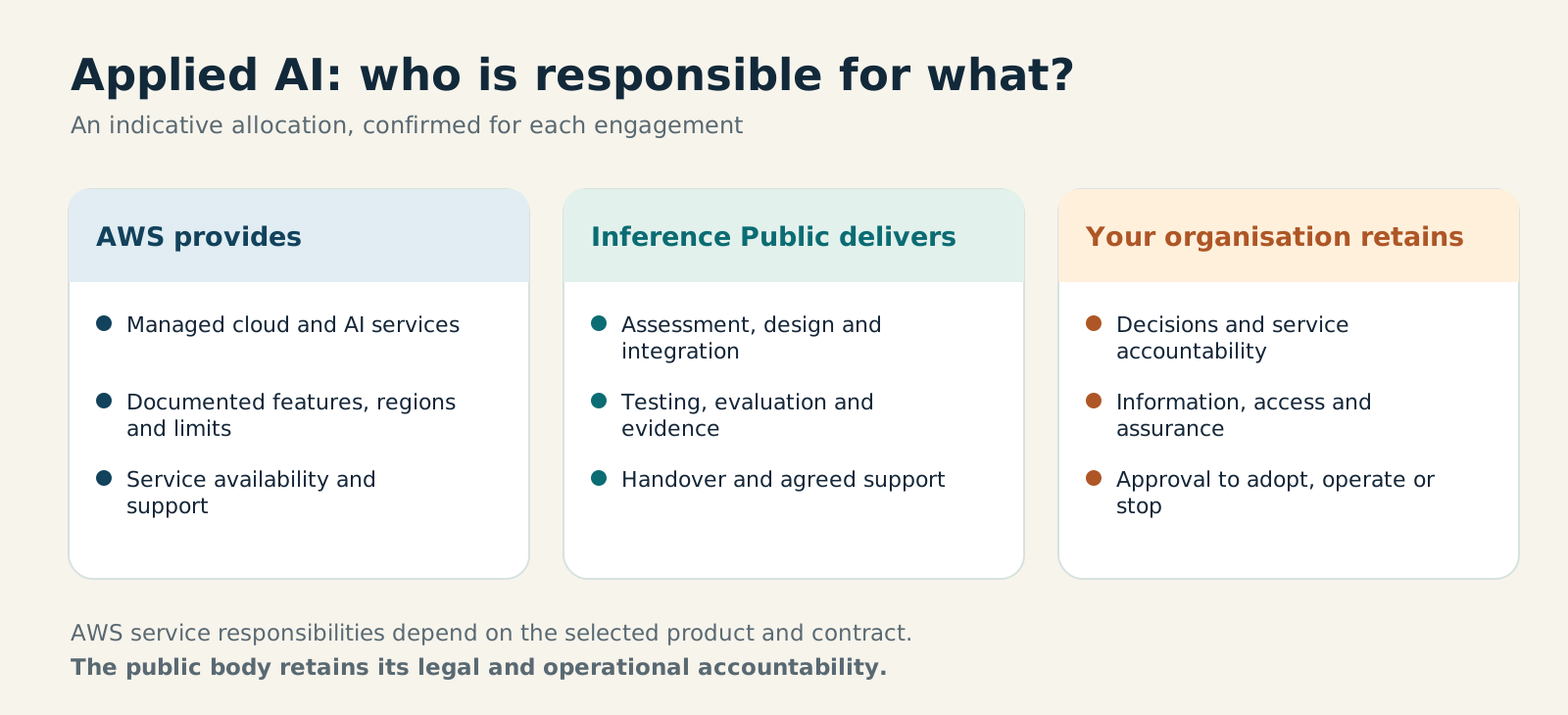
Every engagement separates three kinds of responsibility, because a public body has to know which parts it is buying, which parts AWS operates and which parts it must keep.
| What AWS provides | What we do | What you retain |
|---|---|---|
| Managed services and their documented limits, including where data is stored and processed, how long services are supported and what each can and cannot do | Assessment, architecture, build, integration, testing and evaluation, and the evidence your assurance teams need; handover to your team, or ongoing operation only where that is separately agreed and resourced | Accountable decisions, ownership of your information and data, data protection duties, transparency records where they apply, user permissions, procurement and the decision to proceed or stop |
We usually begin with a short, bounded assessment that ends in a recorded decision, and any build or integration that follows is scoped separately so that you are never committed to more than the evidence supports.
What public bodies are already doing
Records published under the Algorithmic Transparency Recording Standard show what public bodies have built, at what stage and with which controls, although they rarely show whether the service improved. Four records illustrate the range of work on AWS. Each summary reflects the record as we read it on 20 November 2026.
- Defra offers a public assistant that answers questions from its AI guidance toolkit using Claude on Amazon Bedrock in London. The record (published 27 October 2026, updated 17 November 2026) describes a public beta and reports that its tests met four of six pass marks. Read Defra's record
- Newcastle City Council uses Amazon Connect, with assistance for contact centre staff and call transcription. The record (published 13 August 2026) describes the service as in production and lists expected benefits but no measured results. Read Newcastle's record
- The Child Maintenance Service at DWP uses a predictive model on Amazon SageMaker to help caseworkers prioritise about 100,000 cases a month. The record (updated 13 July 2026) reports precision of 0.79 from May 2025 data, which describes the model rather than outcomes for families. Read DWP's record
- The Disclosure and Barring Service produces AI summaries of barring referrals for caseworkers on Amazon Bedrock. The record (published 14 October 2026, updated 17 November 2026) describes a public beta and publishes no evaluation figures. Read DBS's record
None of this is Inference Public's work. For a fuller account of what published public-sector AI projects do and do not show, read What public-sector AI is actually delivering.
Use what already exists
Before building anything, check what is already available to you. Planning authorities in England can use MHCLG's Extract to turn historic planning documents into data; government's own AI tools may cover some needs; and the licences you already hold may include capable assistants. A good assessment considers all of these before recommending new work.
Foundations every route depends on
Whichever route you take, the same disciplines decide whether an AI service can be trusted in operation.
Talk to us
Tell us what work you want to improve and what is getting in the way. We will tell you honestly whether AI is the right answer and, if it is, what a sensible first step would look like.