
AWS Quick can give staff answers from their organisation's own documents, research across many sources and automate routine work. It also reads everything it is connected to, through whatever permissions you already have, and several of its settings cannot be changed once they are made. A convincing demonstration is easy to produce. Evidence that it helps a real service, safely, takes more care.
We help you get that evidence in three stages over about 14 weeks: a short Discovery, a bounded Lighthouse demonstration with one team, and a decision you take on the results. Your SIRO, service owner and information asset owners make the decisions and accept any residual risk. We provide the evidence and a recommendation.
Who this is for
- Central government departments and arm's-length bodies with an AWS estate, knowledge spread across many systems, or teams moving from Amazon Q Business, which is no longer open to new customers. See AWS Quick for central government departments.
- Councils looking at AI for staff guidance, planning, reporting or the work of reorganisation. See AWS Quick for councils.
- Health bodies using Quick for corporate and operational content, where clinical uses are kept separate and handled under clinical safety standards.
If you have not yet chosen between AWS Quick and Microsoft 365 Copilot, start with how to choose between Microsoft 365 Copilot and AWS Quick. Most of the Discovery work applies to either product, because both depend on the permissions and content you already have.
Three stages, one decision
Each stage has a fixed scope, a fixed fee agreed at scoping, and a named output. You can buy Discovery on its own, and stop there if that is the right answer.
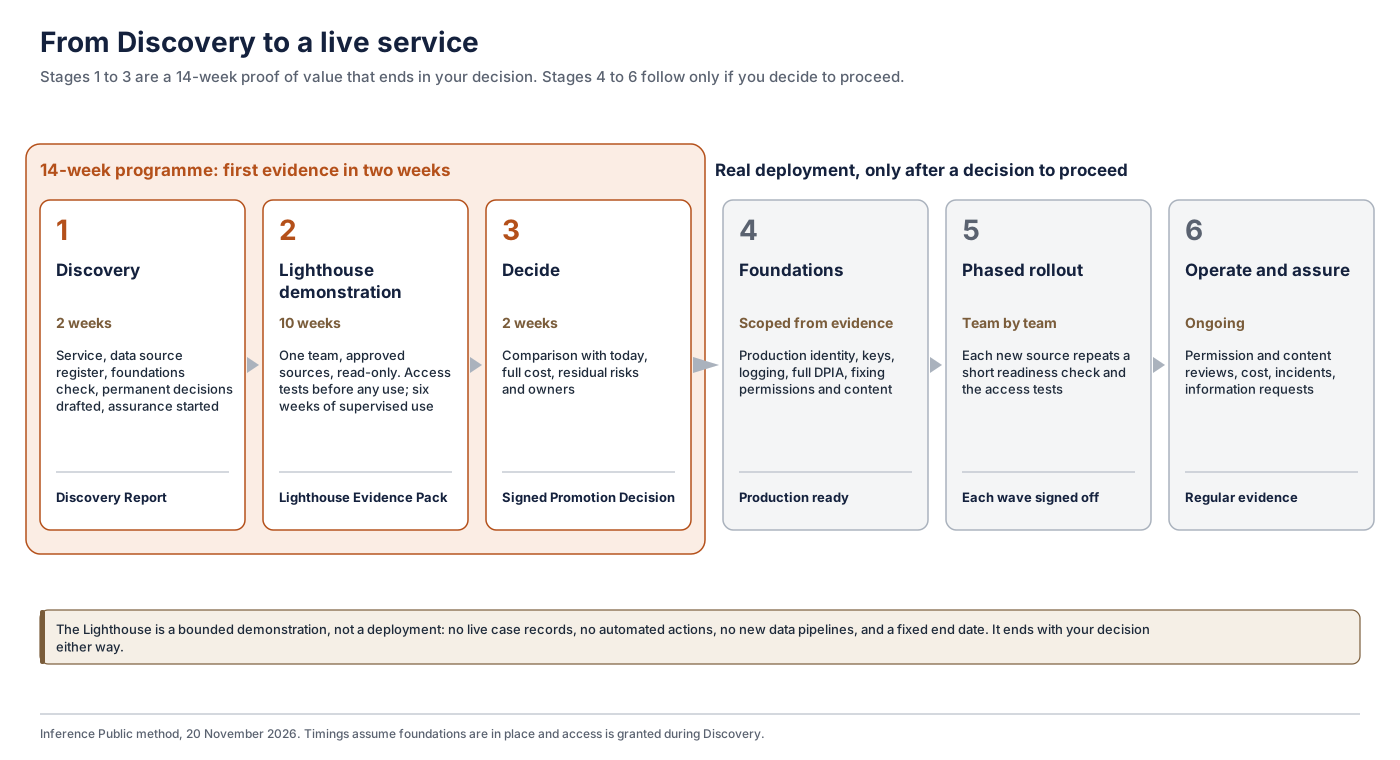
1. Discovery: 2 weeks

You receive: a Discovery Report.
A short, bounded first step that makes no changes to your systems. We work with your digital lead, service owner, information governance and security teams on one service and one task, and establish:
- the service and its baseline: who does the work today, how long it takes, where it goes wrong, and how success would be measured
- the data: a register of each candidate source, covering its owner, how it would reach Quick, a sample check of its quality, whether its permissions are right and would survive the route into Quick, how often it changes, and whether it is due to move or merge. Each source is marked ready, fix first or excluded
- the foundations: whether your AWS landing zone, IAM Identity Center, supplier access, code repository, pipeline and vetting arrangements are ready for a demonstration
- the decisions that cannot be undone: the AWS account, sign-in method, encryption key and knowledge base permission settings, drafted into a decision record for your officers to sign
- assurance and access: DPIA, equality and security work started on day one, and the access the Lighthouse will need requested straight away, because these usually take longest
The report ends with a recommendation: go ahead with a Lighthouse, fix specific things first, use a different approach, or stop. If your data or foundations are the real problem, we will say so in week two rather than discover it in week ten.
2. Lighthouse demonstration: 10 weeks
You receive: a Lighthouse Evidence Pack.
A Lighthouse is a bounded demonstration. It is not a deployment. It answers one question: on your approved content, with your own sign-ins, does AWS Quick help this team do this task better than today, safely?
What keeps it bounded:
- one service, one task, one team of 10 to 25 named staff
- approved sources only, in one or two knowledge bases, with no live resident or case records
- read-only: no writing to case systems and no automated actions. Answers go to staff, never directly to the public
- supervised: staff remain responsible for what they do with an answer, and log problems as they find them
- no pipelines: only sources that work through a native connector or a simple one-off load. A source that needs a pipeline, ETL or migration becomes a sized finding for later, and is not built during the demonstration
- a fixed end date, with success measures and stop rules agreed in Discovery
How the ten weeks run:
| Weeks | What happens |
|---|---|
| 1 to 2 | Build: account, identity, knowledge bases, sources loaded, logging on from the start |
| 3 to 4 | Test and assure: access tests with people who should and should not see content, a baseline of real questions, outage and revocation tests, and completion of DPIA and security sign-off. Go or no-go for staff use |
| 5 | Onboarding: guidance, training, a support route and a way to log issues |
| 6 to 10 | Supervised use by the team on real tasks, with evaluation running through the final two weeks |
A failed access test stops the demonstration before any staff use it. That finding is itself useful evidence. A weak answer-quality score is evidence too, and is reported as such.
The Lighthouse runs in a dedicated AWS account in your landing zone, designed as a candidate production account. At the end it is either retired, with licences cancelled and content and logs handled under the retention rules agreed in Discovery, or carried forward under your decision. It never drifts into live use without one.
3. Decide: 2 weeks
You receive: your Signed Promotion Decision.
We compare the Lighthouse with today's way of working, including review effort, corrections, handoffs, support and any extra burden on the people receiving the service. We set out the full cost of running it, the residual risks and who would own them. Your officers then record one of four decisions:
- proceed within a defined boundary, with named owners and conditions
- fix first, with the exact gaps and the evidence needed to reassess
- continue supervised use, with a revised scope and a review date
- stop, with the reasons
Each is a legitimate outcome. The decision is yours; we provide the evidence behind it.
After the decision
A real AWS Quick deployment continues in three further stages, each scoped from the evidence rather than estimated up front:
- Foundations: production identity and role mapping, keys, logging and retention, the full DPIA, ATRS where needed, a support model, and fixing source permissions and content. In most projects this takes longest, because of the state of permissions and content rather than the difficulty of configuring Quick.
- Phased rollout: team by team and source by source, with each new source going back through a short readiness check and the access tests before it goes live.
- Operate and assure: regular permission and content reviews, cost reporting, and support with incidents and information requests.
We can help with each of these, as Quick Scale & Assurance, once you have decided to proceed.
Before the clock starts
The 14 weeks assume the foundations are in place and that access can be granted during Discovery. Discovery checks this and gives one of three answers:
- Ready: the Lighthouse starts straight after Discovery.
- Partial: a short, fixed foundations sprint comes first, typically 2 to 4 weeks.
- Not there: if there is no landing zone, or IAM Identity Center is not in place, a small landing zone deployment comes first, scoped and priced separately.
The timetable also depends on how quickly your own assurance moves. We will tell you in the first week of Discovery if your approval process makes the plan unrealistic.
How we work
Evidence, labelled honestly. Every claim in our reports is marked as documented by AWS or government sources, tested in an identified configuration, or unknown. We never describe something as tested when it has only been read about.
Stop conditions. Some findings mean "not yet": a security policy that requires customer-managed keys when licensing cannot support them, identities that cannot be reliably matched to source permissions, failed access tests, or records obligations that cannot be met. We report these plainly.
What we need from you. A service owner and a team willing to take part, named technical contacts, access for the people doing the work, the relevant policies, and some representative test identities. Anything missing is recorded as a finding.
Built on the same thinking as our guidance
- why a convincing AI demonstration is not evidence that a public service works
- what public bodies need to check before switching on AWS Quick
- the free AWS Quick readiness checklist
- the AWS Quick FAQ
- use cases for councils, central government and health
- Build RAG, use Bedrock Managed Knowledge Base, or adopt AWS Quick?
- treating RAG as a data product, the reasoning behind our data work in Discovery
If your concern is the state of your content more broadly, our AI-ready data assessment looks at documents, metadata and permissions for any AI assistant.
Buying
- Fees. Each stage has a fixed scope and fee, agreed in writing after a scoping call. You commit to one stage at a time.
- Contracting. Directly with Inference Public. If your organisation needs to buy through a particular framework or route, tell us at the start and we will confirm what we can support.
- AWS charges. Quick subscriptions and other AWS usage are billed by AWS under your existing agreement, separately from our fees. AWS's free trial covers up to 25 users for 30 days, so a ten-week Lighthouse will usually incur a modest subscription cost for the remainder, which we include in the plan.
Who you will work with
Inference Public draws on the safety-engineering and responsibility-assurance discipline developed through Inference Clinical: testing what systems actually do, being clear who is responsible for their effects, and making it possible to find and correct failures. Our team brings around 30 years of experience in digital transformation and public sector technology, gained in roles held before Inference Public was established. We are independent of AWS and Microsoft, and we will tell you if Quick is the wrong choice for what you want to do.
Questions
Is the Lighthouse a pilot?
It is deliberately narrower. Many pilots become live services without anyone deciding they should. A Lighthouse is a bounded demonstration with a fixed end date, read-only access and supervised use, and it ends with your decision either way.
What if our data is not ready?
Then Discovery will show it, usually within the first two weeks. The report sets out which sources are ready, which need fixing and what that would take. Sometimes that is the most valuable result.
Do you only work with AWS Quick?
No. Discovery covers permissions, content ownership, identity and records, which matter for any AI assistant, including Microsoft 365 Copilot. We focus on AWS because that is where we build, and Discovery may recommend a different approach, such as a purpose-built service on Amazon Bedrock.
Is AWS Quick the same as Amazon Quick?
Yes. AWS renamed Amazon Quick to AWS Quick on 9 November 2026. The service is the same.
We are moving from Amazon Q Business. Can you help?
Yes. Treat Quick as a new deployment. Discovery reviews your sources, permissions and retention afresh, rather than copying the Q Business configuration across.
Can AWS or our reseller not just set it up?
They can configure it. Our focus is the decisions that cannot be undone, the state of your data, and evidence that access controls work in your estate, recorded so your officers can sign them off.
Is our data kept in the UK?
When Quick runs in London, your data is stored in London. AI processing may take place in other European regions, and web search is processed in Ireland. We document this feature by feature for your organisation. Our FAQ links to the AWS sources.
Do you have case studies?
Not yet for AWS Quick. When we do, we will publish them only with the client's written consent and with outcomes they are willing to state publicly.
Talk to us
Tell us about the service you want to improve and where you are with AWS Quick. We will reply within two working days to arrange a short scoping call.